

Why Safe Water Matters for Colorado Homeowners
A UV water purification system uses ultraviolet light to disinfect water by inactivating harmful microorganisms like bacteria, viruses, and protozoa. Here’s what you need to know:
How UV Water Purification Works:
- UV-C light at 254 nm wavelength disrupts the DNA/RNA of pathogens
- Inactivates 99.99% of bacteria, viruses, and parasites (including Cryptosporidium and Giardia)
- Chemical-free disinfection with no taste, odor, or disinfection byproducts
- Point-of-entry (POE) systems treat all water entering your home
- Requires pre-filtration with sediment filters to ensure water clarity
Key Specifications to Consider:
- Flow rate measured in gallons per minute (GPM)
- UV dose requirement: minimum 40 mJ/cm² for Class A systems
- UV lamp life: typically 1 year (9,000-10,000 hours)
- Ultraviolet Transmittance (UVT): must be greater than 75-95%
Safe drinking water is paramount. Even with generally safe municipal water in the Denver Metro area, your home’s plumbing can affect water quality. For homeowners with private wells, the risk is higher as untreated water is vulnerable to bacteria, viruses, and other microorganisms.
UV purification is a powerful, chemical-free solution. It doesn’t alter water’s taste or smell, simply neutralizing pathogens as water flows past a UV lamp. This proven technology is popular for whole-house protection.
The challenge? Not all UV systems are created equal. Choosing the wrong size or skipping essential pre-treatment can lead to ineffective disinfection. You need to understand flow rates, UV dosage, and maintenance to make an informed decision.
This guide covers how UV water purification systems work, their best applications, key specifications, and maintenance for reliable protection.
I’m Chris Hoffman, a Master Plumber with over 25 years of experience in the Denver Metro and Elbert County areas. I’ve helped many homeowners, especially those with private wells, install the right UV water purification system to protect their families. Let’s explore how to select the best system for your home.
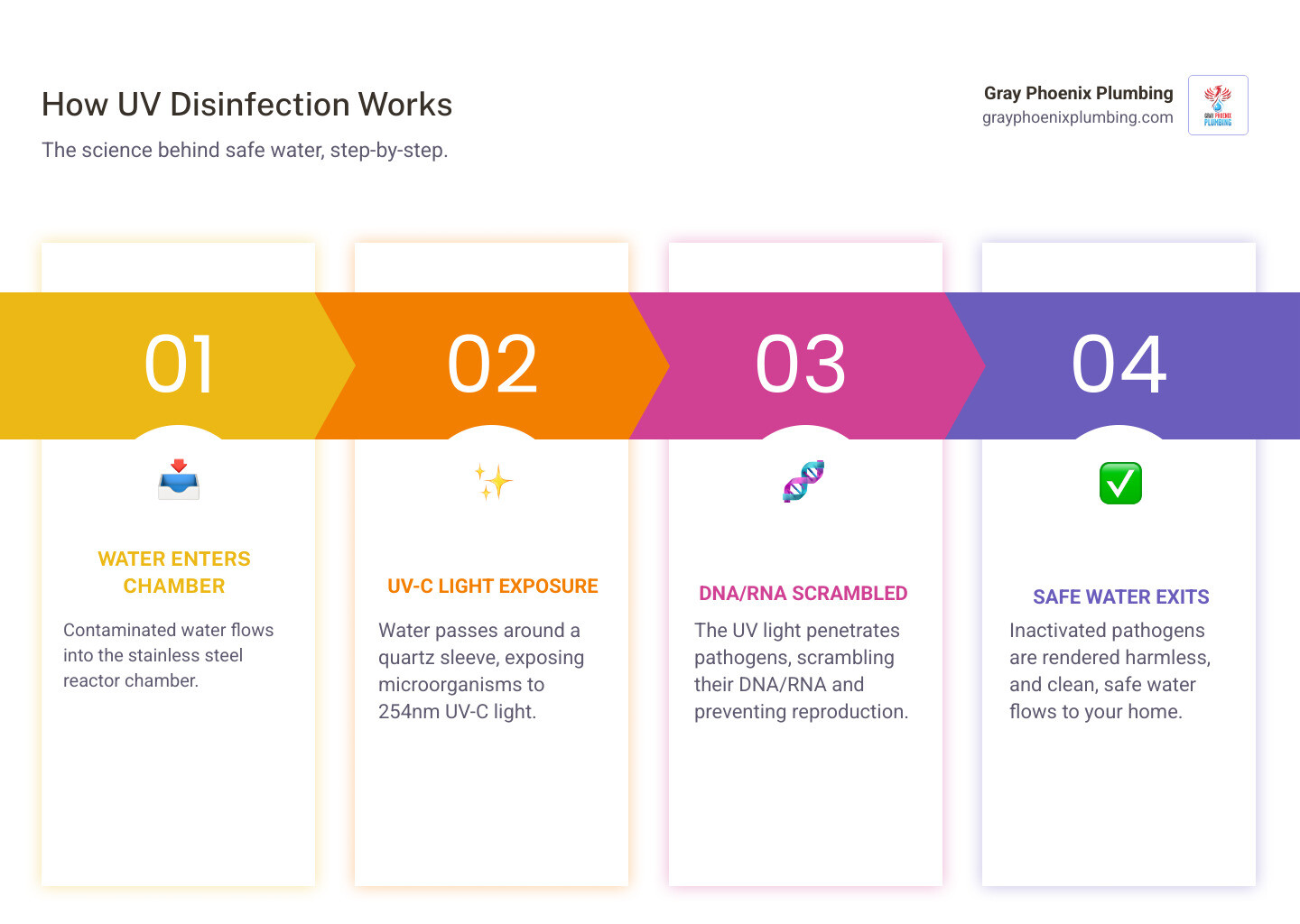
How UV Disinfection Works: The Science Behind Safe Water
A UV water purification system uses light, not chemicals, to neutralize harmful microorganisms. The system employs germicidal UV-C light at a specific wavelength, around 254 nanometers (nm), that is highly effective at disrupting the DNA and RNA of microorganisms.
When water flows through the UV chamber, these potent UV-C rays penetrate the cells of bacteria, viruses, and other pathogens, scrambling their genetic material. Once their DNA is damaged, these microorganisms cannot reproduce or cause illness. They are effectively inactivated and flushed away with the water. This process is remarkably effective, reducing 99.99% of bacteria and viruses.
This method is particularly powerful against common waterborne pathogens like E. coli, Giardia, and Cryptosporidium. While some chemical treatments struggle with chlorine-resistant parasites like Cryptosporidium, UV light tackles them head-on.
Key Components of a UV Water Purification System
Understanding the main components of a UV water purification system helps with maintenance:
- UV Lamp: The heart of the system, this lamp emits the germicidal UV-C light. Most residential systems use low-pressure mercury vapor lamps efficient at producing the 254 nm wavelength. These lamps have a finite lifespan, typically one year or 9,000-10,000 hours of continuous operation.
- Quartz Sleeve: The UV lamp is housed inside a protective quartz sleeve. This sleeve protects the lamp from water while allowing UV light to pass through. Quartz is used because it doesn’t block UV-C rays. The sleeve must be kept clean and typically lasts about two years.
- Stainless Steel Reactor Chamber: This is the main body of the unit, where water is exposed to UV light. It’s usually made from durable, corrosion-resistant stainless steel, which also helps reflect UV rays to maximize exposure.
- Controller/Ballast: This electronic component powers the UV lamp. Modern controllers often include alarms that alert you to lamp replacement needs or system faults.
- Flow Restrictor: This crucial component ensures water doesn’t rush through the chamber too quickly. This guarantees adequate “dwell time”—the period of UV exposure—for effective disinfection. Without it, some pathogens might pass through untreated.
Measuring Effectiveness: UV Dose and Transmittance (UVT)
Effectiveness is measured by two key factors: UV dose and Ultraviolet Transmittance (UVT).
UV Dose, measured in millijoules per square centimeter (mJ/cm²), is the amount of UV energy delivered to the water. Different microorganisms require different doses for inactivation. The dose combines UV light intensity and exposure time (dwell time). For broad-spectrum disinfection, a minimum UV dose of 40 mJ/cm² is the standard.
Several factors influence the required UV dose:
- Susceptibility of Microorganisms: Some pathogens, like certain viruses, are more resistant to UV light than others.
- UV Reactor Design: The chamber’s design affects how uniformly water is exposed to UV light.
- Flow Rate: If water flows too quickly, it receives a lower dose.
- Water’s UVT: This is where our second measurement comes in.
Ultraviolet Transmittance (UVT) measures how much UV light can pass through your water, expressed as a percentage. A higher percentage means clearer water. This is important because anything in the water that blocks UV light—like sediment, iron, or turbidity—shields microorganisms. Manufacturers specify minimum UVT values, typically greater than 90-95%, for their systems to operate effectively. If your water’s UVT is too low, the UV dose will be insufficient for proper disinfection.
This highlights why proper pre-treatment is so crucial. If your water is cloudy or has dissolved solids, the UV system won’t work effectively. The CDC emphasizes understanding your water quality before installing any treatment system. You can learn more from the CDC’s guide: Technical Information on Home Water Treatment Technologies.
The Pros, Cons, and Best Applications for UV Systems
Understanding the unique advantages and disadvantages of a UV water purification system can help clarify the path when choosing a water treatment method.
Benefits of UV Water Purification
UV disinfection brings a lot to the table for safeguarding your family’s water:
- Highly Effective Disinfection: UV systems are incredibly powerful, reducing 99.99% of bacteria and viruses. They are particularly effective against chlorine-resistant microorganisms like Cryptosporidium and Giardia, a concern for well owners in Elbert County.
- Chemical-Free Treatment: Unlike chlorination, UV purification adds no chemicals to your water. This means no chemical taste, odor, or harmful disinfection byproducts. Your water remains pure, just disinfected.
- No Change to Water Properties: Because no chemicals are involved, UV treatment doesn’t alter your water’s pH or mineral content.
- Fast-Acting: Disinfection happens almost instantly as water passes through the chamber. There’s no waiting period for chemicals to work.
- Low Energy Use: UV systems are generally energy-efficient, drawing power comparable to a standard light bulb (typically 22W-55W).
- Water Reuse & Sustainability: By offering effective, chemical-free disinfection, UV water purification systems contribute positively to water reuse initiatives. They allow for safe water treatment without introducing new pollutants, supporting sustainability goals.
Limitations and Pre-Treatment Needs
While UV systems are fantastic, they aren’t a standalone solution for all water problems. It’s important to understand their limitations:
- No Residual Disinfection: This is the primary drawback. Unlike chlorine, UV light doesn’t leave a disinfecting residual in your pipes. If contamination occurs after the UV unit, the water won’t be protected. Maintaining good hygiene in your water system is paramount.
- Ineffective on Turbid or Cloudy Water: As discussed with UVT, particles in water can shield microorganisms from UV light, rendering disinfection ineffective. This is why proper pre-filtration is essential.
- Requires Electricity: A UV system won’t work during a power outage. For critical applications, a backup power source is a consideration.
- Doesn’t Remove Chemicals or Sediment: UV light only inactivates microorganisms. It won’t remove heavy metals, pesticides, chlorine, or sediment. For these, additional filtration is needed.
This brings us to the crucial need for pre-treatment. To ensure your UV water purification system operates at peak efficiency, we always recommend:
- A 5-micron Sediment Filter: This is non-negotiable. It removes larger particles that could create “shadows” for the UV light.
- Water Softeners for Hard Water: If you have hard water (common in many parts of Colorado), minerals can build up on the quartz sleeve, forming scale. This scale blocks UV light, drastically reducing effectiveness. A water softener prevents this.
Common Applications
UV water purification systems are versatile and can be applied in various settings:
- Whole-House Water Treatment: Installed at the point-of-entry (POE), a whole-house UV system treats all water you use. This is vital for homes with private wells in areas like Elbert County, Castle Rock, or Parker, where there’s no municipal treatment. Our systems are designed to reduce 99.99% of bacteria and viruses that may be in your water.
- Private Well Water: Wells are exposed to potential contamination from runoff, septic systems, or wildlife. A UV system is your primary defense against microbiological threats.
- Municipal Water “Polishing”: Even on city water in Denver or Colorado Springs, a UV system provides an extra layer of safety against rare contamination or during boil water advisories.
- Rainwater Harvesting Systems: For those using rainwater, UV disinfection is an excellent way to make that water safe for various uses.
It’s important to note the distinction between UV water purification systems for drinking water and those for ponds or fish tanks. Pond UV clarifiers are designed to control algae, not to produce water safe for human consumption. “UV units for ponds and fish tanks are not suitable for human consumption supplies.”
For a deeper dive into how different filtration methods can complement UV purification, explore our professional water filtration systems: More info about our water filtration systems.
Choosing the Right UV Water Purification System for Your Home
Selecting the ideal UV water purification system for your home in Elizabeth, CO, or anywhere in our service areas, requires careful consideration. It’s not a one-size-fits-all solution, and getting it right ensures effective, long-term protection.
Sizing the System
The most critical factor in choosing a UV system is its flow rate, measured in gallons per minute (GPM). This determines how much water the system can disinfect effectively at any given moment. An undersized system means water will flow through too quickly, receiving an insufficient UV dose, and leaving you unprotected. As we often say, it’s always better to oversize a UV system than to undersize it.
We typically size systems based on your household’s peak water usage, which can be estimated by the number of bathrooms:
- 1 bathroom home: 6 GPM or greater
- 2 bathrooms: 8 GPM or greater
- 3 bathrooms: 10 GPM or greater
- 4 bathrooms: 12 GPM or greater
If your home has more than four bathrooms, or if you have high-flow fixtures like multiple showerheads, we’ll help you calculate your specific peak demand to ensure your system can handle it.
Another important consideration is the NSF/ANSI 55 standards. This certification helps categorize UV systems:
- Class A Systems: Certified to deliver a UV dose of at least 40 mJ/cm². These are designed for disinfecting microbiologically unsafe water, making them the standard choice for homes with private wells or where water quality is a concern.
- Class B Systems: Certified to deliver a UV dose of at least 16 mJ/cm². These are intended for supplemental bacterial treatment of already disinfected potable water, not for treating contaminated sources. For whole-house protection in areas like Elbert County, Class A is almost always the recommendation.
Specifications for Your UV Water Purification System
Beyond flow rate, here are other key specifications to consider:
- Flow Rate (GPM): As discussed, match this to your household’s needs. Systems range from 5 GPM for smaller homes up to 18 GPM for larger ones.
- Power (Wattage): This indicates the UV lamp’s power consumption. Common wattages are 22W, 25W, 35W, 40W, and 55W. Higher wattage often correlates with higher flow rate capacity and disinfection power.
- Dimensions: Consider the physical size of the unit to ensure it fits in your designated installation space, typically near your main water line. Products like the VIQUA VH410 are around 21 inches in height and 6 inches in width/depth.
- Port Size: This refers to the size of the inlet/outlet connections, commonly 3/4 MNPT (Male National Pipe Thread).
- Lamp Life Indicator: A crucial feature! This tells you when your UV lamp is nearing the end of its life, prompting you for replacement.
- Alarm Features: Look for systems with alarms that alert you to lamp failure, low UV intensity, or other operational issues. These “failsafe” devices are vital to ensure you’re never unknowingly consuming untreated water.
Special Considerations for Well Water
For our friends with private well water in Elbert County, Kiowa, Franktown, or other rural parts of Colorado, UV water purification systems are often a cornerstone of a comprehensive water treatment plan. However, well water presents unique challenges:
- Higher Risk of Bacteria and Viruses: Unlike municipal water, well water is untreated and can be highly susceptible to contamination from various sources. This makes a reliable disinfection method like UV critical.
- Mandatory Water Testing: Before installing any system, it’s absolutely essential to get your well water tested. This will reveal not only the presence of bacteria and viruses but also levels of iron, manganese, hardness, and turbidity, which all impact UV system performance.
- Class A Systems Recommended: Due to the potential for microbiological contamination, we always recommend NSF/ANSI 55 Class A certified UV systems for well water.
- Pre-Treatment for Specific Well Water Issues: Well water often contains high levels of:
- Iron: Should be less than 0.3 mg/L. Iron can stain fixtures and, more importantly, coat the quartz sleeve, blocking UV light.
- Manganese: Should be less than 0.05 mg/L. Similar to iron, manganese can cause fouling.
- Hardness: Should be less than 120 mg/L (7 grains per gallon). Hard water leads to scale buildup on the quartz sleeve, reducing UV effectiveness. A water softener is often needed.
- Turbidity: Must be less than 1 NTU (Nephelometric Turbidity Unit). Cloudy water shields pathogens. A good sediment filter is a must.
- Color: Significant color in water can also absorb UV light.
Addressing these issues before the UV system ensures the UV light can do its job properly. The EPA provides an excellent overview of various drinking water treatment technologies, including pre-treatment options: Overview of Drinking Water Treatment Technologies.
Installation, Maintenance, and Long-Term Costs
Investing in a UV water purification system is a smart move for your home’s water safety, but proper installation and routine maintenance are key to its longevity and effectiveness.
We always recommend professional installation for UV water purification systems. While some homeowners might consider a DIY approach, the precise plumbing, wiring, and water flow dynamics are best left to licensed professionals like our team at Gray Phoenix Plumbing. We ensure your system is installed correctly as a Point-of-Entry (POE) device, treating all water entering your home. Vertical installation is often preferred for better flow and easier maintenance. Our licensed, background-checked pros serve Elizabeth, CO, and the broader Denver Metro area, including Parker, Castle Rock, and Colorado Springs, ensuring your system is set up for optimal performance.
Routine Maintenance: Lamp and Sleeve Replacement
The beauty of a UV system is its relatively low maintenance, but “low” doesn’t mean “no.” A few simple, critical tasks will keep your system running perfectly:
- Annual UV Lamp Replacement: The UV lamp is designed to last about one year, or 9,000-10,000 hours. Even if the lamp still glows, its germicidal intensity diminishes over time, making it less effective. Marking your calendar for an annual lamp change is a must for consistent protection.
- Quartz Sleeve Cleaning: Periodically, you’ll need to clean the quartz sleeve’s exterior. Minerals and sediment can build up, creating a barrier that blocks UV light. We recommend cleaning it during your annual lamp replacement, or more frequently if your water is prone to mineral deposits.
- Bi-Annual Sleeve Replacement: While UV lamps are replaced annually, the quartz sleeve typically lasts about two years. Over time, quartz can degrade or become etched with mineral deposits, affecting UV light transmission.
- Using Genuine Parts: Always use genuine replacement lamps and sleeves recommended by the manufacturer. Generic parts might not meet exact specifications, compromising your system’s effectiveness and potentially voiding warranties.
Our team at Gray Phoenix Plumbing can handle all your UV system maintenance needs, ensuring your system continues to provide safe, clean water. We also offer comprehensive services for water heaters and other filtration systems: More info about water heaters and filtration systems.
Frequently Asked Questions about UV Purifiers
We often hear similar questions from homeowners considering or already owning a UV water purification system. Let’s clear up some common curiosities!
Does a UV system make water safe to drink from any source?
A UV system is incredibly effective at inactivating bacteria, viruses, and protozoa, making water microbiologically safe. However, it’s crucial to remember that it only disinfects; it doesn’t filter out chemicals, heavy metals, sediment, or other non-biological contaminants. So, while it’s a powerful tool for making microbiologically contaminated water safe (especially well water), it needs to be part of a multi-barrier approach if your water source has other issues. For instance, water with high levels of lead, pesticides, or excessive sediment would require additional filters before the UV unit to be considered truly safe for drinking.
Will a UV purifier change the taste of my water?
One of the biggest advantages of a UV water purification system is that it operates entirely without chemicals. This means it will not alter the taste, odor, or pH of your water. If you’ve ever noticed a “chlorine taste” in tap water, you’ll appreciate that UV systems avoid this entirely. Your water will simply be disinfected and pure, without any added flavors or smells.
How much electricity does a UV system use?
UV water purification systems are generally quite energy-efficient. Most residential units consume between 22 and 55 watts of power, which is comparable to a standard incandescent light bulb. This means the impact on your electricity bill is minimal, often just a few dollars a month, making it an economical choice for continuous disinfection compared to the cost of bottled water or other chemical treatments. They run 24/7 to ensure constant protection, but their low wattage keeps operating costs down.
Conclusion: Is a UV System the Right Choice for You?
After diving into UV water purification systems, you might be asking: is this the right solution for my home?
For many homeowners in Elizabeth, CO, Elbert County, and across the Denver Metro area, a UV system offers an unparalleled level of water safety and peace of mind. Its ability to inactivate 99.99% of bacteria and viruses without chemicals is a significant benefit, especially for families with private well water or those seeking extra protection from municipal water advisories. You get clean, disinfected water that retains its natural taste and odor with low operating costs.
The ideal candidate for a UV water purification system is someone who:
- Relies on private well water and needs reliable disinfection.
- Wants chemical-free water treatment to avoid chlorine taste and byproducts.
- Seeks a comprehensive whole-house solution for safe water at all taps.
- Is safety-conscious and wants to protect their family from waterborne illnesses.
- Is prepared to perform simple, routine maintenance like annual lamp replacement.
The key to an effective UV system lies in proper sizing, essential pre-treatment (like sediment filters and water softeners), and consistent maintenance. This ensures the UV light can penetrate your water and deliver the necessary germicidal dose.
At Gray Phoenix Plumbing, we’re experts in helping homeowners choose, install, and maintain the perfect water treatment solutions. We understand the specific water challenges in our service areas, from hard water in Castle Rock to well water in Elbert County. Our team is here to guide you, ensuring your family enjoys safe, clean water every day.
Ready to explore how a professional UV water purification system can transform your home’s water quality? Reach out to us today, and let’s make your water worries a thing of the past.


