

Why Understanding Tankless Water Heater Pros and Cons Matters for Your Home
Tankless water heater pros and cons are critical to understand before making a significant investment in your home’s hot water system. These modern units promise energy savings and endless hot water, but they also come with higher upfront costs and potential limitations.
Quick Answer: Tankless Water Heater Pros and Cons
| Pros | Cons |
|---|---|
| Energy Efficient – 24-34% more efficient for low usage, 8-14% for high usage | Higher Upfront Cost – $800-$3,500+ for installation vs. ~$900 for traditional |
| Endless Hot Water – On-demand heating means no running out | Limited Flow Rate – May struggle with multiple simultaneous uses |
| Longer Lifespan – 20+ years vs. 10-15 years for tank heaters | Complex Installation – Often requires gas line or electrical upgrades |
| Space-Saving – Wall-mounted, compact design | Maintenance Required – Annual descaling and professional servicing needed |
| Lower Utility Bills – Average savings of $70-$100+ per year | “Cold Water Sandwich” – Brief cold bursts when demand fluctuates |
Nothing starts the day off better than a hot shower—but what happens when that hot water runs out before you finish? Traditional tank water heaters store 40-80 gallons of hot water, but once it’s gone, you’re left waiting. Tankless systems promise to solve this problem by heating water only when you need it, delivering a continuous supply without the limitations of a storage tank.
But are they right for every home? The answer depends on your household size, budget, water usage patterns, and existing infrastructure. A tankless system can save you hundreds of dollars annually on energy costs and last twice as long as a traditional heater, but the initial investment can be three times higher, and homes with high simultaneous water demand may need multiple units to keep up.
I’m Chris Hoffman, a Master Plumber with over 25 years of experience installing and servicing both traditional and tankless water heating systems throughout the Denver Metro area. I’ve guided countless homeowners through the tankless water heater pros and cons, helping them understand which system best fits their specific needs, budget, and home infrastructure.
What is a Tankless Water Heater and How Does It Work?
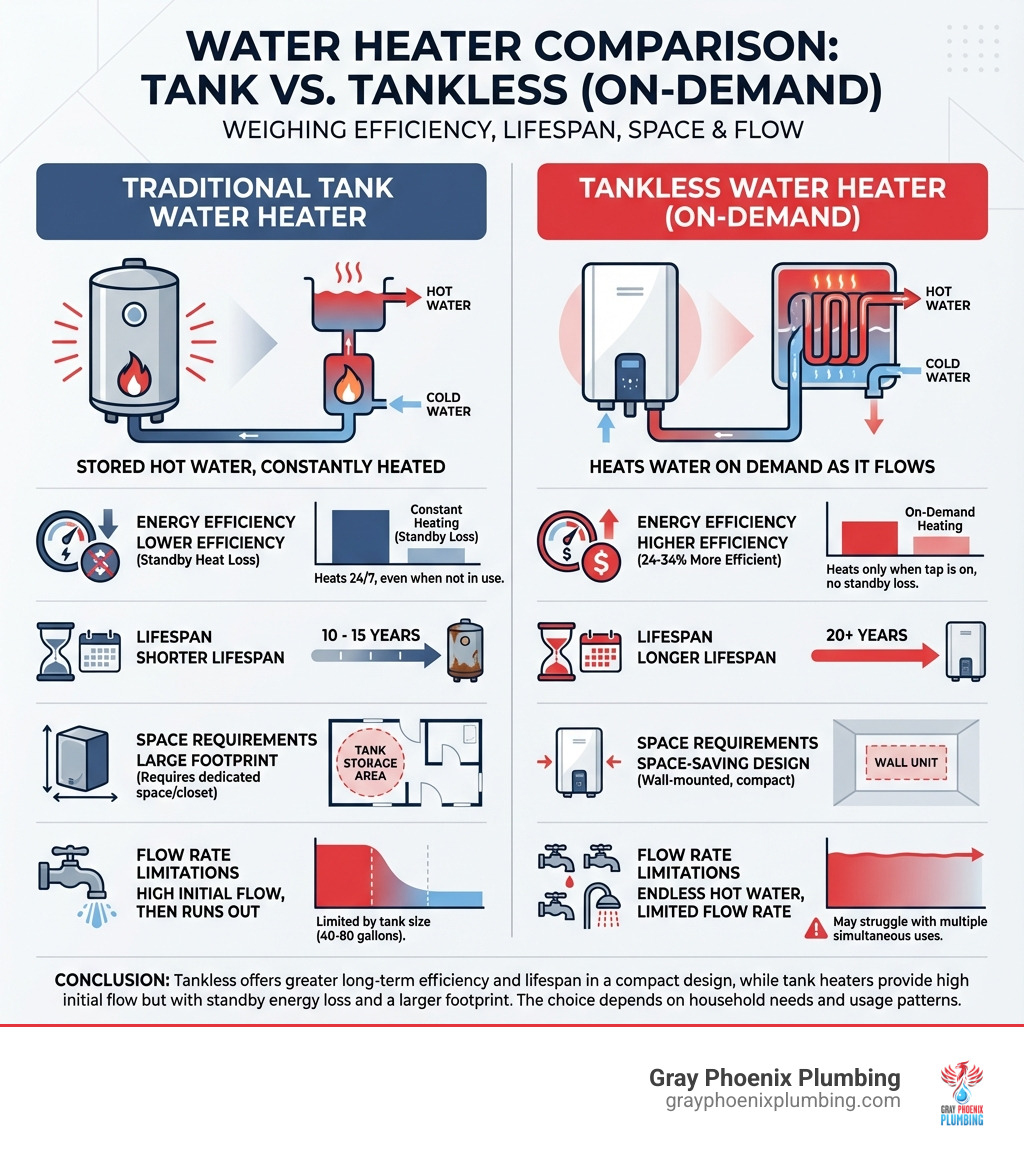
When we talk about water heaters, most of us picture a large, cylindrical tank sitting in a basement or utility closet. That’s the traditional method. A tankless water heater, also known as an on-demand or instant water heater, is a completely different beast. Instead of storing and continuously heating gallons of water, it heats water only when you need it.
Here’s how it works: When you turn on a hot water tap, cold water flows into the tankless unit. Inside, a powerful heat exchanger is activated by either a gas burner or an electric element. As the water passes through this heat exchanger, it’s rapidly heated to your desired temperature, then sent directly to your faucet or appliance. The unit stops heating as soon as you turn off the tap. This on-demand technology eliminates the “standby heat loss” that traditional tank heaters constantly experience by keeping a large volume of water hot 24/7.
To give you a clearer picture, here’s a quick comparison:
| Feature | Traditional Tank Water Heater | Tankless Water Heater |
|---|---|---|
| Lifespan | 10-15 years | 20+ years |
| Upfront Cost | Lower (unit + installation ~$900) | Higher (unit + installation $800-$3,500+) |
| Energy Use | High (continuous heating, standby loss) | Lower (on-demand heating, no standby loss) |
| Space | Large, bulky tank (40-80 gallons) | Compact, wall-mounted (size of a briefcase) |
| Hot Water | Limited by tank capacity, can run out | Continuous supply (limited by flow rate) |
The Traditional Tank Heater Method
The traditional tank heater is what many of us grew up with. It’s a simple system: a large tank filled with water is heated by a gas burner or electric elements and kept at a set temperature. The downside? This constant heating means energy is always being used, even when no one is home or using hot water. This is what we call “standby loss.”
The capacity of these tanks typically ranges from 40 to 80 gallons. Once you’ve used up that hot water, you have to wait for the tank to refill and reheat, which can take a while. When choosing a traditional tank water heater, you’d look at its “first-hour rating,” which tells you how many gallons of hot water it can deliver in an hour, starting with a full tank. This helps us size it correctly for your family’s peak usage. You can learn more about Sizing a traditional water heater to ensure you pick the right capacity.
The On-Demand Tankless Method
The on-demand tankless method completely bypasses the need for a storage tank. When you open a hot water faucet, cold water flows into the unit, sensors detect the flow, and a powerful heating element (either gas or electric) instantly heats the water to your desired temperature as it passes through. This means you get hot water only when you need it, and it keeps coming as long as you need it.
Instead of tank capacity, we talk about “flow rate” (measured in gallons per minute, or GPM) and “temperature rise” for tankless units. The GPM indicates how much hot water the unit can deliver at one time. For example, a gas tankless unit might offer 5-10 GPM, while an electric unit typically provides 2-5 GPM. The “temperature rise” refers to how much the unit can raise the incoming cold water’s temperature. In colder climates like Colorado, where groundwater can be quite chilly, a tankless unit needs to work harder to achieve the desired hot water temperature, potentially impacting its effective flow rate. This is why proper sizing is crucial. For more information, check out More about on-demand heaters.
The Ultimate Guide to Tankless Water Heater Pros and Cons
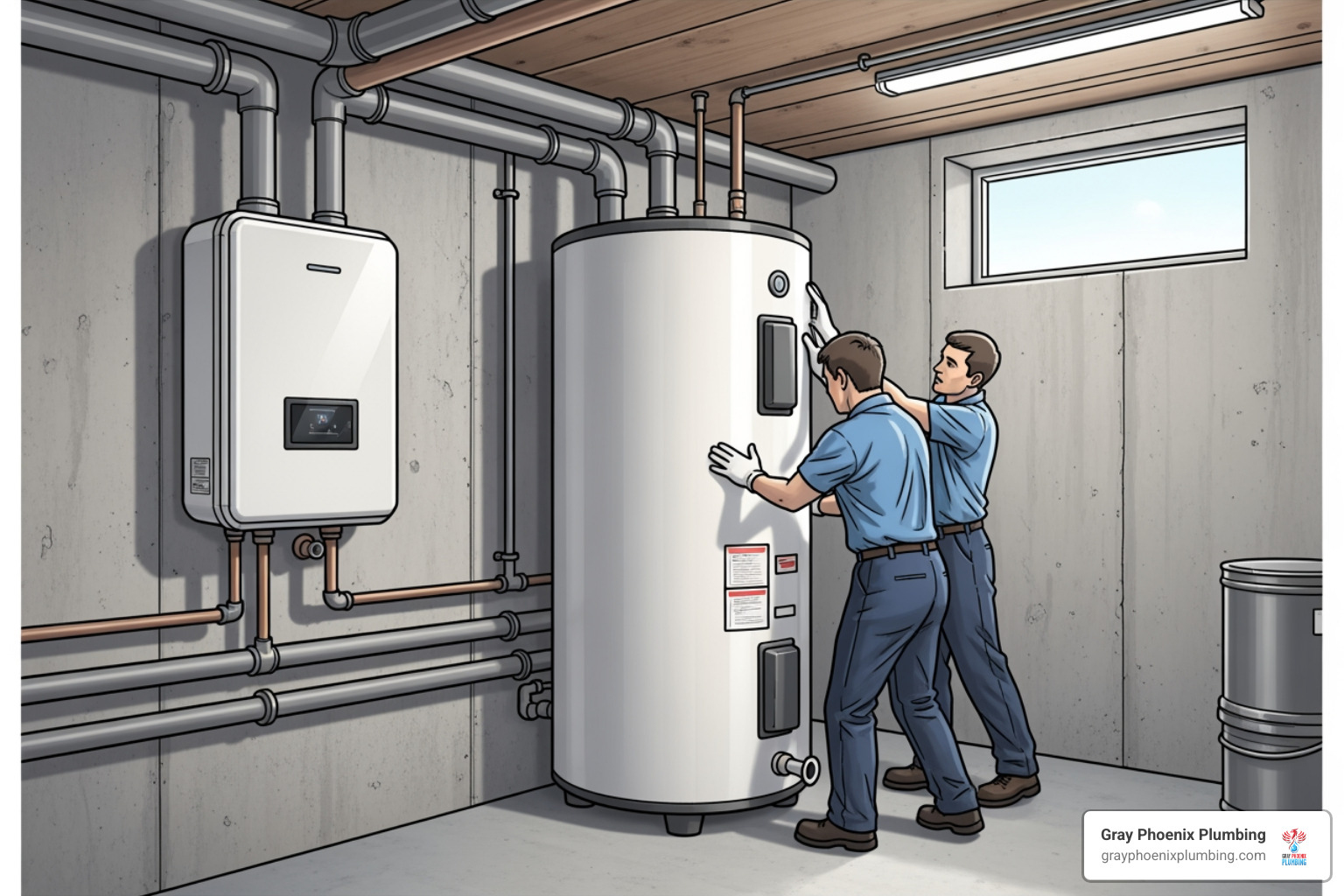
Deciding on a new water heater involves weighing several factors: energy savings, upfront cost, expected lifespan, and, of course, the availability of hot water. Let’s explore the core tankless water heater pros and cons to help you understand if this technology is the right fit for your Denver-area home.
The Pros: Unpacking the Advantages of Tankless Water Heaters
Tankless water heaters offer a compelling list of benefits that make them an attractive option for many homeowners:
- Endless Hot Water: This is often the most appealing benefit. Because water is heated on demand, you never run out. No more cold showers because someone else took a long one! You can fill a large soaking tub, run the dishwasher, and do a load of laundry all at the same time without worrying about the water turning icy.
- Energy Efficiency & Lower Utility Bills: Traditional tank heaters continuously heat water, leading to significant standby energy losses. Tankless units, however, only activate when hot water is called for, eliminating this waste. Research shows that tankless water heaters can be 24-34% more energy efficient for homes using 41 gallons or less daily, and 8-14% more efficient for homes using around 86 gallons per day. Overall, they use 30-50% less energy than tank units, potentially saving a typical family about $70-$100 or more per year on energy bills. We love helping our customers save money where they can!
- Longer Lifespan: A significant advantage of tankless systems is their durability. While traditional tank water heaters typically last 10-15 years, a quality tankless unit can last over 20 years, nearly double the lifespan. This means fewer replacements and less hassle over the long run. If your current water heater is showing its age, exploring a tankless option might be a smart move for your next Water Heater Replacement.
- Space-Saving Design: Tankless water heaters are compact, often no larger than a small suitcase, and can be mounted on a wall. This frees up valuable floor space in your utility closet, garage, or basement that a bulky storage tank would normally occupy. For smaller homes or those looking to maximize space, this is a huge plus.
- Reduced Risk of Leaks: Without a large tank constantly holding gallons of water, the risk of a catastrophic leak or burst is significantly reduced. While no system is entirely leak-proof, the potential for water damage from a tankless unit is much lower, offering homeowners in places like Elizabeth, CO, and Castle Rock, CO, greater peace of mind.
- Precise Temperature Control: Many tankless models offer precise temperature control, allowing you to set the exact hot water temperature you desire. This can be a great safety feature, preventing scalding, especially in homes with young children or elderly residents.
The Cons: Key Drawbacks of Tankless Water Heaters to Consider
Despite their many benefits, tankless water heaters aren’t without their downsides, and it’s important to consider these carefully:
- Higher Initial Cost: This is often the biggest hurdle. The upfront purchase price for a tankless unit is typically higher than a traditional tank heater. When you factor in installation, the average cost for tankless systems can exceed $3,000, compared to about $900 for tank-style models. While long-term savings can offset this, it’s a significant initial investment.
- Limited Flow Rate & Simultaneous Use Issues: While tankless units provide endless hot water, they have a “flow rate” limit. This means they can only heat a certain amount of water per minute. If you have multiple hot water demands simultaneously—say, two showers, a dishwasher, and a washing machine all running at once—a single tankless unit might struggle to keep up, leading to reduced water pressure or lukewarm water. Gas tankless units generally offer higher flow rates (5-10 GPM) than electric models (2-5 GPM), but even they can be overwhelmed in large, busy households.
- “Cold Water Sandwich” Effect: This is a peculiar phenomenon unique to tankless systems. If you briefly turn off the hot water (e.g., while lathering in the shower) and then turn it back on, you might experience a short burst of cold water before the hot water returns. This happens because the water sitting in the pipes between the heater and the faucet has cooled, and the tankless unit needs a moment to reactivate and reheat the new incoming water. It’s not a deal-breaker for most, but it can be surprising!
- Installation Complexity & Potential Infrastructure Upgrades: Installing a tankless water heater is not a DIY project. It requires professional expertise and often involves significant adjustments to your home’s existing infrastructure. For gas models, this might mean upgrading your gas line from a standard 1/2-inch to a 3/4-inch line to supply enough fuel. For electric models, the power demands are substantial (over 25,000 watts for a whole-house unit), often requiring a dedicated 30-amp circuit and potentially an electrical panel upgrade. These upgrades add to the overall installation cost and complexity.
- Maintenance Needs: To ensure their long lifespan and efficient operation, tankless water heaters require annual maintenance, primarily descaling. Minerals in our water, especially in areas with hard water like parts of Colorado, can build up in the heat exchanger, reducing efficiency and eventually causing issues. This annual service, typically costing between $45 and $200, is crucial and best performed by a licensed plumber. Ignoring it can shorten the unit’s life and void warranties.
Types, Costs, and Installation Insights
Navigating tankless water heaters can feel a bit overwhelming with all the different types and considerations. But don’t worry, we’re here to break it down for you. Understanding the options, costs, and installation requirements is key to making an informed decision for your home in Denver, Littleton, or Aurora.
Different Types of Tankless Water Heaters
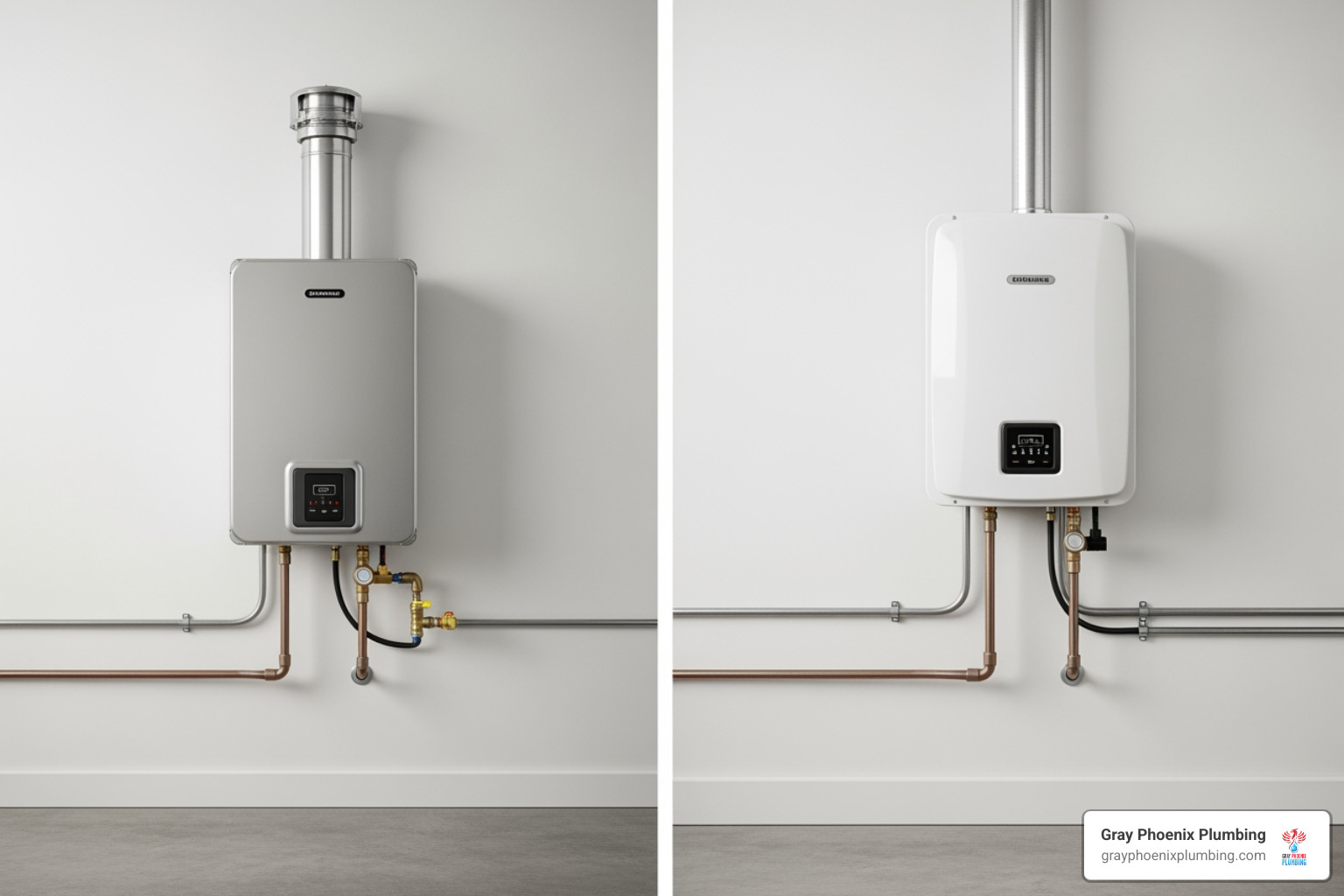
Tankless water heaters primarily differ by their fuel source and how they manage exhaust:
- Gas-Fired Tankless Water Heaters: These are generally more powerful, offering higher flow rates (5-10 GPM) suitable for whole-house applications, even for larger families. They typically come in two main types:
- Non-Condensing Gas: These are often less expensive units but require specialized stainless-steel venting due to hot exhaust gases. This can increase installation costs. They are around 80-85% efficient.
- Condensing Gas: These models are more efficient (up to 99%) because they use a secondary heat exchanger to capture heat from the exhaust gases, pre-warming the incoming cold water. This also means cooler exhaust, allowing for less expensive PVC venting, which can lower installation costs despite a higher unit price.
- Electric Tankless Water Heaters: These units are typically smaller, easier to install (no gas line or venting needed), and boast higher efficiency ratings (98% or more). However, they generally have lower flow rates (2-5 GPM), making them better suited for smaller homes, point-of-use applications, or supplemental heating rather than whole-house solutions for large families.
- Point-of-Use Units: These are smaller tankless heaters designed to provide hot water to a single faucet or appliance, such as a kitchen sink or a bathroom vanity far from the main hot water source. They minimize the wait time for hot water and can be either gas or electric.
- Whole-House Systems: These are larger, more powerful tankless units designed to meet all the hot water demands of an entire home. Depending on your household’s size and water usage, a single whole-house unit may suffice, or larger homes might opt for multiple strategically placed units.
The Financial Breakdown: Cost, Savings, and Incentives
Let’s talk numbers. The financial aspect is a major part of the tankless water heater pros and cons.
- Upfront Purchase Price: The cost of the unit itself varies significantly. Electric tankless units generally range from $500 to $1,500, while gas tankless units typically cost between $1,000 and $2,000.
- Installation Costs: This is where the overall investment often jumps. Average installation costs can add another $1,000 to $3,000, depending on the complexity of the job and necessary infrastructure upgrades (gas lines, electrical panels, venting). For a detailed look, check out our guide on Tankless Hot Water Installation Cost.
- Long-Term Energy Savings: While the initial outlay is higher, the energy savings are real. As we mentioned, tankless units can save a family $70-$100 or more annually on utility bills due to their increased efficiency. These Energy efficiency statistics from energy.gov highlight these potential savings.
- Payback Period: The time it takes for your energy savings to offset the higher upfront cost can range from 10 to 25 years. Electric tankless models often have faster payback periods than gas models due to lower installation costs, though operating costs can vary based on local utility rates.
- Federal Tax Credits and Rebates: To encourage energy-efficient upgrades, the government often offers incentives. For example, ENERGY STAR certified gas tankless water heaters with a Uniform Energy Factor (UEF) greater than 0.95 may be eligible for federal tax credits and rebates of up to $600 or 30% of the project cost. We can help you identify any applicable programs in Colorado.
Installation and Maintenance: What to Expect
The installation of a tankless water heater is a job for experienced professionals, not a weekend warrior project. Our team at Gray Phoenix Plumbing emphasizes safety and precision for every installation in areas like Parker, Castle Rock, and Golden.
- Professional Installation is Key: Due to the complexities of gas lines, electrical demands, and venting, professional installation is strongly recommended. Attempting a DIY installation can lead to safety hazards, costly errors, and even void your warranty. Our Install Tankless Water Heater Complete Guide provides more insight into what’s involved.
- Venting Requirements: Gas tankless units produce exhaust gases that must be safely vented outside. Non-condensing models require costly stainless-steel venting, while more efficient condensing models can use less expensive PVC pipes. Proper venting is crucial for safety and efficiency.
- Gas Line Upgrades: Many homes, especially older ones, have 1/2-inch gas lines. However, gas tankless water heaters often require a larger 3/4-inch gas line to ensure an adequate fuel supply. This upgrade is a common part of the installation process.
- Electrical Panel Upgrades: Electric tankless water heaters draw a significant amount of power. A whole-house electric unit can demand over 25,000 watts and usually requires a dedicated 30-amp circuit, which might necessitate an upgrade to your home’s electrical panel.
- Annual Maintenance: To keep your tankless unit running efficiently for its 20+ year lifespan, annual maintenance is essential. This primarily involves descaling the unit to remove mineral buildup, especially in areas with hard water. Our experienced plumbers in Denver perform these services, ensuring your system operates optimally.
- Hard Water Effects: Colorado water can be quite hard, meaning it contains higher levels of minerals like calcium and magnesium. Over time, these minerals can accumulate in your tankless water heater’s heat exchanger, forming scale. This buildup reduces efficiency, increases energy consumption, and can eventually cause the unit to malfunction. If you’re in an area with particularly hard water, we often recommend installing a water softener to protect your investment. Regular descaling is also a must. If you notice any issues, our team is ready for Plumber Same Day Water Heater Repair Denver.
Is a Tankless System the Right Choice for Your Home?
Deciding between a tankless and traditional water heater isn’t a one-size-fits-all answer. It depends heavily on your specific household needs, water usage habits, budget, home layout, and even the climate in our beautiful state of Colorado. We’ve helped families in Centennial, Lakewood, and Colorado Springs steer these choices.
When a Tankless Water Heater is a Great Fit
A tankless water heater shines in several scenarios:
- High Value on Energy Savings: If reducing your carbon footprint and saving money on utility bills is a top priority, the long-term energy efficiency of a tankless unit is a significant draw.
- Limited Space: For homes where space is at a premium, the compact, wall-mounted design of a tankless heater is a game-changer, freeing up valuable square footage.
- Desire for Endless Hot Water: If your family frequently runs out of hot water, or you have high demand for continuous hot water (e.g., large soaking tubs, multiple showers), a tankless system can provide the continuous supply you crave.
- New Construction or Major Remodels: These are ideal times to install a tankless unit, as infrastructure upgrades (gas lines, electrical, venting) can be easily integrated into the project without major disruption.
- Small Homes or Vacation Properties: For smaller households with lower overall hot water demand, a tankless unit can be incredibly efficient. In vacation homes or second homes, tankless heaters are perfect because they only heat water when needed, eliminating standby losses during periods of vacancy and reducing the risk of leaks while you’re away.
When a Traditional Tank Might Be Better
Sometimes, the tried-and-true traditional tank water heater is still the better option:
- Lower Upfront Budget: If your primary concern is the initial cost, a traditional tank heater will almost always be less expensive to purchase and install.
- Very High Simultaneous Water Demand: For very large families or homes where multiple high-flow hot water appliances (like several showers, a washing machine, and a dishwasher) are routinely used at the exact same time, a traditional tank, or even multiple tankless units, might be more suitable to avoid flow rate limitations.
- Older Homes with Difficult-to-Upgrade Infrastructure: If your home’s gas lines or electrical system would require extensive and costly upgrades to accommodate a tankless unit, the overall investment might not be worthwhile.
- Simpler Installation Preference: If you prefer a simpler installation process with fewer potential infrastructure modifications, a like-for-like replacement of a traditional tank might be less disruptive.
- Colder Climates (with specific considerations): While tankless units work well in Colorado, the colder incoming groundwater means they need to work harder. If you have extremely high hot water demands in winter, we’d carefully assess whether a gas tankless unit (which generally handles temperature rise better) or even a traditional tank with a large first-hour rating is the optimal solution for your specific needs in places like Conifer or Evergreen.
Conclusion: Making the Final Decision
Choosing the right water heater for your home is a significant decision that impacts your daily comfort, energy bills, and long-term budget. We’ve explored the comprehensive tankless water heater pros and cons, from their energy-saving capabilities and endless hot water supply to their higher upfront costs and specific installation requirements.
The best choice depends on your specific needs. If you value continuous hot water, desire significant energy savings over the long term, have space constraints, and are prepared for the initial investment and potential infrastructure upgrades, a tankless water heater could be an excellent fit for your home. However, if budget is your primary concern, or your household has exceptionally high simultaneous hot water demands that might exceed a single unit’s flow rate, a traditional tank heater might still be a more practical choice.
No matter your situation, we believe in providing personalized advice. For expert advice and professional installation in the Denver area, including Littleton, Parker, and Castle Rock, the licensed team at Gray Phoenix Plumbing can assess your home’s needs and provide a transparent quote. We’re here to ensure you make the right choice for comfortable, reliable hot water for years to come. Don’t hesitate to reach out to us for a professional Get a professional tankless water heater installation in Denver service.


