

Why Understanding Heat Pump Water Heaters Matters for Your Home
As energy costs rise, more homeowners are asking: heat pump water heater how it works? The simple answer is that it works like a refrigerator in reverse. Instead of creating heat, it moves existing heat from the surrounding air into your water tank.
This process involves four main steps:
- Pulling heat from the air with a fan.
- Amplifying the heat by compressing a refrigerant.
- Transferring this heat to the water in the tank.
- Using backup electric elements only when hot water demand is high.
This method of moving heat instead of making it makes these units 3-4 times more efficient than standard electric water heaters. This can lead to using 70% less energy and saving a typical household around $550 per year on electricity bills.
Most models are “hybrid” units, combining the heat pump with traditional electric elements to ensure you never run out of hot water. As a Master Plumber with over 25 years of experience in the Denver Metro area, I can confirm that this technology has matured significantly, and the energy savings are real.
The Core Principle: How a Heat Pump Water Heater Works
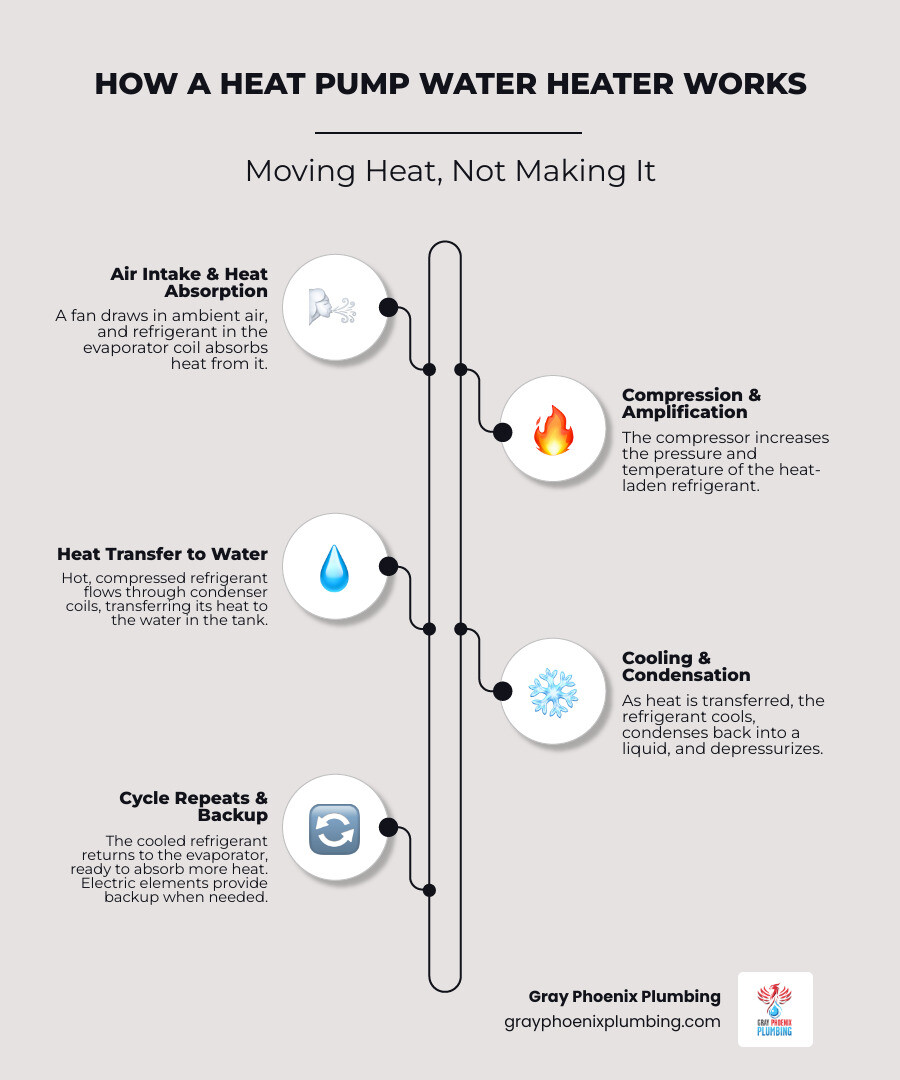
A heat pump water heater (HPWH) is less about “making” heat and more about “moving” it. This fundamental difference is what makes it so efficient. While traditional water heaters create heat by burning gas or using electric resistance (like a toaster), an HPWH extracts existing heat from the surrounding air and transfers it to the water in its tank. This process, known as the refrigeration cycle, uses significantly less electricity. In fact, it allows an HPWH to be up to three to four times more efficient than a standard electric water heater.
The ambient air in your basement or garage in areas like Elizabeth or Parker, CO, serves as a free heat source. Even on a cool day, there’s enough thermal energy in the air for the HPWH to use effectively.
The Main Components of a Heat Pump Water Heater
To understand how an HPWH works, let’s look at its key components:
- Evaporator: A fan draws ambient air over a coil filled with liquid refrigerant. The refrigerant absorbs heat from the air and evaporates into a gas.
- Compressor: This component uses electricity to pressurize the refrigerant gas, which dramatically increases its temperature.
- Condenser Coils: The hot, high-pressure gas flows through coils wrapped around the water tank. The heat transfers from the coils to the colder water, heating it up.
- Refrigerant: This special fluid is the workhorse, cycling between liquid and gas to move heat.
- Fan: Draws air into the unit and exhausts the now-cooler, dehumidified air back into the room.
- Insulated Storage Tank: A well-insulated tank stores the heated water until it’s needed.
- Backup Electric Resistance Elements: Most HPWHs are hybrid models that include conventional electric heating elements. These provide supplemental heat during periods of high demand or if the ambient air is too cold (below 40°F).
The Step-by-Step Heating Process
Here’s a walkthrough of the continuous heating cycle:
- Fan Draws in Air: A fan pulls warm air from the surrounding space into the unit.
- Refrigerant Absorbs Heat: The air passes over the evaporator coil, and the cold refrigerant inside absorbs the heat, turning into a gas.
- Compressor Increases Temperature: The gas moves to the compressor, which pressurizes it, making it much hotter.
- Heat Transfer to Water: The superheated gas flows through the condenser coils, transferring its heat to the water in the storage tank.
- Refrigerant Cools and Condenses: As it loses heat, the refrigerant cools and condenses back into a liquid.
- Cycle Repeats: The liquid refrigerant passes through an expansion valve, which lowers its pressure and temperature, preparing it to start the cycle again.
This efficient process uses electricity primarily to power the fan and compressor, not to generate all the heat from scratch.
Unpacking the Incredible Efficiency and Benefits
The primary reason homeowners in places like Aurora and Castle Rock are switching to heat pump water heaters is their unparalleled efficiency, which translates into significant cost savings and a smaller environmental footprint.
Understanding Key Performance Metrics: UEF and FHR
Two key metrics help measure a water heater’s performance:
- Uniform Energy Factor (UEF): This is the standard for measuring energy efficiency. A higher UEF means greater efficiency. HPWHs have UEFs from 3.5 to 4.0, meaning for every unit of electricity consumed, they deliver 3.5 to 4 times that amount in heat to your water. This is possible because they pull most of the heat from the surrounding air. In contrast, traditional electric water heaters have a UEF below 1.0.
- First Hour Rating (FHR): This metric tells you how many gallons of hot water a unit can deliver in one hour. It’s crucial for ensuring your water heater can meet your household’s peak demand, like on busy mornings in Westminster or Brighton.
The Triple Win: Cost, Energy, and Environment
Choosing a heat pump water heater offers a triple win for Colorado homeowners:
- Energy Savings Up to 70%: An ENERGY STAR certified HPWH is up to four times more efficient than a standard electric model, using up to 70% less energy.
- Annual and Lifetime Cost Savings: These energy savings can save a household of four approximately $550 per year on electric bills. Over the unit’s lifetime, this could add up to more than $5,600.
- Reduced Carbon Footprint: By using less electricity, HPWHs significantly reduce the carbon impact of heating water. As Colorado’s grid gets cleaner, these benefits will only grow.
- Improved Indoor Air Quality: Unlike gas water heaters, HPWHs don’t produce combustion gases like carbon monoxide, making your home safer.
Learn more about ENERGY STAR certified models and find the right one for your home.
Smart Features, Operating Modes, and Types of HPWHs
Modern heat pump water heaters are intelligent systems designed to adapt to your needs and maximize savings. Understanding their modes and types will help you choose the perfect fit for your Colorado home.
Your Control Center: Understanding the Operating Modes
Most hybrid HPWHs offer several operating modes to customize performance. Common modes include:
- Heat Pump Only / Economy Mode: The most energy-efficient setting, relying solely on the heat pump. It’s best for maximum savings but has a slower recovery time.
- Hybrid / Auto Mode: The default setting that balances efficiency and performance. It prioritizes the heat pump but uses electric elements for high demand, ensuring you always have hot water.
- Electric / High Demand Mode: Operates like a traditional electric water heater, using only the resistance elements for the fastest recovery. This is the least efficient mode and should be used sparingly.
- Vacation Mode: Maintains water at a low temperature to prevent freezing and save energy while you’re away.
When hosting guests in Centennial or Agate, you can switch to Hybrid or Electric mode to ensure ample hot water, then revert to Economy mode for daily use.
| Mode | Function | Best For |
|---|---|---|
| Heat Pump Only (Economy) | Uses only the heat pump. Most efficient, lowest cost, slower recovery. | Maximizing energy savings with consistent, moderate hot water demand. |
| Hybrid (Auto) | Prioritizes heat pump but uses electric elements for high demand. | Everyday use, balancing savings with consistent hot water availability. |
| Electric (High Demand) | Uses only electric elements. Least efficient, fastest recovery. | Situations requiring rapid hot water, like when hosting many guests. |
| Vacation | Maintains a low tank temperature to save energy while you’re away. | Extended periods away from home to prevent freezing and wasted energy. |
Exploring Different Types of Heat Pump Water Heaters
- Integrated (All-in-One) Units: The most common type, with the heat pump built on top of the storage tank. They are ideal for most homes in Colorado.
- Split-System HPWHs: These separate the heat pump (located outside) from the indoor storage tank. This is great for homes with limited indoor space or to minimize indoor noise.
- Geothermal Integration (Desuperheater): For homes with geothermal systems, a desuperheater can use waste heat from the system to pre-heat your water, often providing hot water for free during summer cooling.
Modern Features and Smart Technology
Today’s HPWHs come packed with smart features:
- Digital Control Panels: For easy adjustment of settings and modes.
- Wi-Fi Connectivity and Smartphone Apps: Allow for remote management, energy usage tracking, and alerts.
- Leak Detection Alerts: Some models can detect leaks and send an alert to your phone, potentially preventing water damage.
- Grid Connectivity: Smart grid-capable units can communicate with your utility for demand response programs, which can save you money by adjusting operation during peak electricity times.
Installation and Maintenance: What Every Homeowner Needs to Know
Proper installation and routine maintenance are key to getting the most out of your heat pump water heater. While the long-term savings are substantial, HPWHs have specific requirements that differ from traditional water heaters.
Key Installation Requirements
Our plumbers at Gray Phoenix Plumbing consider several factors for a successful installation:
- Space Requirements: HPWHs need air to function. They require at least 700 cubic feet of air space (e.g., an 8×12-ft room). Smaller spaces need louvered doors or other ventilation strategies.
- Temperature Range: They operate most efficiently between 40°F and 90°F, making unconditioned basements or garages in Colorado ideal locations. Below 40°F, they rely on less-efficient backup heating.
- Condensate Drain Management: HPWHs dehumidify the air, creating condensate (water) that must be drained. We’ll connect a drain line to a floor drain, sink, or condensate pump.
- Clearance and Electrical: The unit needs adequate clearance for access and maintenance. Most HPWHs require a dedicated 240-volt, 30-amp circuit, similar to a standard electric water heater.
Potential Drawbacks and How to Mitigate Them
While HPWHs are a great choice, it’s good to be aware of a few considerations:
- Higher Initial Cost: The upfront price is higher than for conventional heaters, but this is often offset by energy savings and available rebates and tax credits.
- Slower Recovery Time: In the most efficient mode, recovery can be slower. We mitigate this by properly sizing the unit for your family’s needs or using Hybrid mode for peak demand.
- Noise Levels: The fan and compressor produce a low hum (45-55 dBA), similar to a modern refrigerator. Installing them in basements or garages minimizes any disturbance.
- Localized Cooling Effect: The unit exhausts cool, dry air. This is a benefit in the summer (free AC and dehumidification) but is a factor to consider for placement in winter.
Simple Maintenance for Long-Lasting Performance
Routine care is straightforward and ensures your HPWH runs efficiently for years:
- Clean the Air Filter: Clean the filter every 6-12 months to ensure good airflow.
- Check the Condensate Drain: Annually check that the drain line is clear.
- Flush the Tank: Periodically flush the tank to remove sediment, just like a traditional water heater.
- Anode Rod Inspection: The anode rod protects the tank from corrosion and should be inspected periodically. We can handle this as part of our water heater maintenance services.
Frequently Asked Questions about How a Heat Pump Water Heater Works
We get a lot of questions from Colorado homeowners about heat pump water heaters. Here are answers to the most common ones.
Will a heat pump water heater provide enough hot water for my family?
Yes, absolutely. The key is proper sizing and using the right settings. We ensure this by:
- Sizing Correctly: We focus on the First Hour Rating (FHR) to make sure the unit can meet your family’s peak demand.
- Upsizing the Tank: A slightly larger tank can increase efficiency by reducing the need for backup electric heating. This is especially useful in Colorado where incoming water can be very cold.
- Using Hybrid Mode: For times of high demand, like when guests are visiting, switching to Hybrid mode ensures you won’t run out of hot water. You can switch back to the more efficient mode for normal daily use.
Will installing one inside my house make my heating bill go up in the winter?
This is a common concern, but the impact is minimal for most homes. The cooling effect is localized and usually not enough to affect your thermostat. Any small increase in heating cost is far outweighed by the significant savings on your water heating bill. Plus, in the summer, this localized cooling and dehumidification is a free benefit that can reduce the load on your air conditioner.
How do they compare to tankless water heaters?
Both are excellent, efficient options, but they suit different needs. Here’s a quick comparison:
- Efficiency: HPWHs are generally more efficient than electric tankless models. The comparison with gas tankless depends on local utility rates.
- Installation: HPWHs need space and airflow. Electric tankless units often require costly electrical upgrades. Gas tankless units need proper venting and a gas line.
- Hot Water Delivery: HPWHs provide hot water from a tank, which is replenished very efficiently. Tankless units provide endless hot water on demand but can be limited by flow rate if too many fixtures are used at once.
The best choice depends on your home, budget, and usage patterns. For more on tankless options, see our guide on tankless water heaters in Littleton.
Conclusion: Is a Heat Pump Water Heater Right for Your Home?
After exploring heat pump water heater how it works, its impressive efficiency, diverse operating modes, and installation considerations, you can see why this technology is gaining so much traction in Colorado. For homeowners in Elizabeth, Denver, Colorado Springs, and beyond, an HPWH represents a truly modern approach to hot water—one that aligns with both financial prudence and environmental responsibility.
You’re not just getting hot water; you’re investing in:
- Unparalleled Efficiency: Utilizing ambient air to heat your water, leading to significantly lower energy bills.
- Long-Term Savings: With potential savings of hundreds of dollars annually and thousands over the unit’s lifetime, an HPWH pays for itself.
- Environmental Stewardship: Reducing your carbon footprint and contributing to a cleaner, greener Colorado.
- Smart Home Integration: Modern features offer convenience and control right from your smartphone.
At Gray Phoenix Plumbing, we believe in empowering our customers with knowledge and providing solutions that truly make a difference. If you’re looking to upgrade to a more efficient water heating system, we’re here to help you steer the options, assess your home’s specific needs, and ensure a seamless installation. We’re your trusted, licensed, and background-checked pros, offering transparent pricing and a Customer Care Guarantee.
Ready to take the next step towards energy-efficient hot water? Or perhaps you’re considering other options like tankless? Whether it’s a heat pump or considering a tankless water heater installation in Denver? Contact us today!, we’re here to ensure your home has the perfect hot water solution.


