

Why Water Heating Is One of Your Biggest Energy Expenses
Heat pump water heaters are a super-efficient technology that can slash your water heating costs by up to 70% compared to standard electric models. Here’s what you need to know:
What is it? A heat pump water heater uses electricity to move heat from the surrounding air into water, rather than generating heat directly—like a refrigerator working in reverse.
Key Benefits:
- 2-3 times more energy efficient than conventional water heaters
- Saves $470-$600 per year on energy bills for a typical household
- Qualifies for a 30% federal tax credit (up to $2,000)
- 13-15 year lifespan vs. 10-12 years for traditional units
What it costs:
- Upfront: $1,500-$5,000+ (including installation)
- Payback period: Typically 3 years
- Lifetime savings: Over $4,500 compared to standard electric
Installation needs: Requires adequate space (700+ cubic feet of air), a condensate drain, and proper electrical supply (usually 240V).
Water heating accounts for around 20% of your home’s energy use—second only to heating and cooling. That’s a big chunk of your utility bill every month. Traditional electric and gas water heaters generate heat directly, which is inherently less efficient. But there’s a smarter way.
Heat pump water heaters represent a major leap forward in home energy efficiency. Instead of creating heat, they move it from one place to another. This fundamental difference is why they can deliver hot water up to five times more efficiently than standard models.
The technology isn’t new—heat pump water heaters have been available for over 40 years—but recent improvements in efficiency, reliability, and cost have made them an increasingly attractive option for homeowners. With generous federal tax credits and utility rebates now available, the financial case for upgrading has never been stronger.
This guide will walk you through everything you need to know: how the technology works, what it costs upfront and over time, what to consider before installation, and whether it’s the right choice for your home in Elizabeth, CO, and the surrounding areas.
I’m Chris Hoffman, a Master Plumber with over 25 years of experience, and I’ve installed and serviced countless water heating systems, including modern heat pump water heater installations that help homeowners dramatically reduce their energy bills. Let me share what I’ve learned to help you make an informed decision.
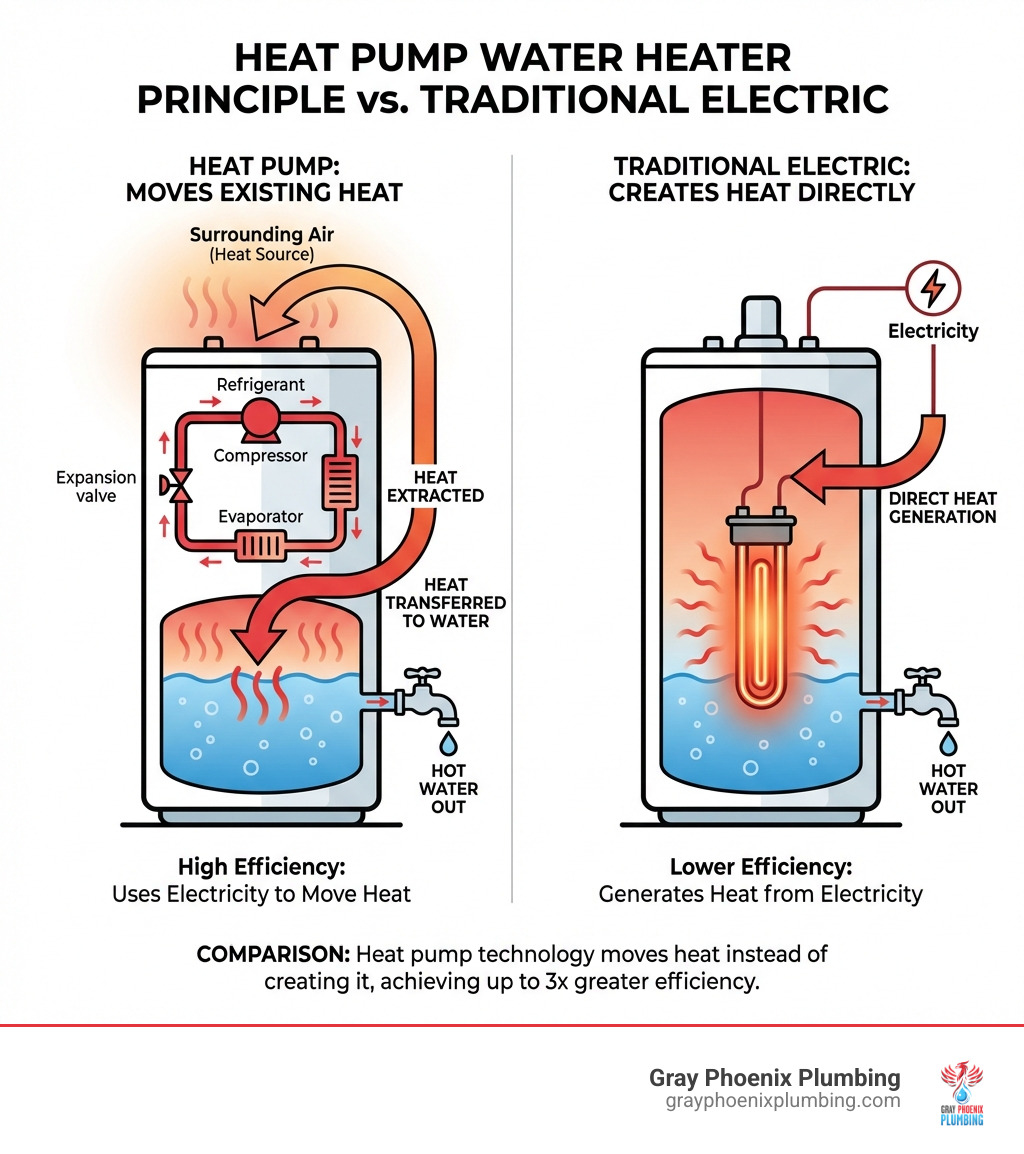
How a Heat Pump Water Heater Works and Its Key Benefits
Imagine a refrigerator, but in reverse. While your fridge pulls heat out of its interior to keep food cold, a heat pump water heater (HPWH) pulls heat from the surrounding air and transfers it into the water inside its tank. This ingenious method allows it to heat water without directly generating heat, making it incredibly efficient.
The core principle involves a refrigerant that absorbs heat from the ambient air, then gets compressed to increase its temperature. This superheated refrigerant then transfers its heat to the water in the tank. It’s a continuous cycle that effectively “pumps” heat from the air into your water supply.
Many heat pump water heaters are also known as “hybrid” water heaters because they combine this heat pump technology with traditional electric resistance heating elements. This hybrid functionality is crucial during periods of very high hot water demand or when the ambient air temperature is too low for the heat pump to operate efficiently. In these scenarios, the electric resistance elements kick in as a backup, ensuring you never run out of hot water, even if you’re hosting a houseful of guests!
The Major Advantages Over Traditional Heaters
The benefits of a heat pump water heater go far beyond just providing hot water. They represent a significant upgrade for your home’s energy profile and overall comfort.
Energy Efficiency: This is the star of the show! Heat pump water heaters are champions of energy efficiency. They can be two to three times more energy efficient than conventional electric resistance water heaters, and up to five times more efficient than standard electric, gas, or propane models. This means they consume up to 70 percent less energy compared to a standard electric model. This efficiency is measured by the Uniform Energy Factor (UEF), where a higher number indicates better performance. We’ll dive deeper into UEF later, but for now, just know that HPWHs typically boast UEFs far above 1.0, while traditional electric models are usually below 1.0.
Cost Savings: The energy efficiency directly translates into substantial savings on your utility bills. A typical household can save an average of $470 to $600 per year in energy costs. For a family of four, these savings can be even more significant, potentially exceeding $500 annually. Over the lifetime of the unit, this can add up to more than $4,500 to $5,600 in savings, which is a pretty sweet deal!
Environmental Benefits: By consuming significantly less energy, heat pump water heaters drastically reduce your home’s carbon footprint. They produce fewer greenhouse gas emissions and don’t burn fossil fuels inside your home, which means no carbon monoxide (CO) or nitrogen dioxide (NO2) emissions. Choosing a heat pump water heater is a tangible step towards a more sustainable and eco-friendly home.
Home Safety: Speaking of no combustion gases, this is a huge safety benefit. Traditional gas water heaters carry the inherent risk of carbon monoxide leaks. By switching to an electric heat pump water heater, you eliminate this potential source of dangerous fumes, making your home a cleaner and safer environment.
Dehumidification Effect: Here’s a neat trick many homeowners appreciate: heat pump water heaters don’t just extract heat; they also pull moisture from the air as part of their operation. This means they can act as a natural dehumidifier in humid spaces like basements or utility rooms. If you’re tired of running a separate dehumidifier, a HPWH could offer a dual benefit!
For more in-depth information on how these remarkable systems work, you can always check out the U.S. Department of Energy’s guide on how heat pump water heaters operate.
Comparing Water Heater Types
To truly appreciate the advancements of a heat pump water heater, let’s stack it up against its more traditional counterparts.
| Feature | Heat Pump Water Heater | Standard Electric | Standard Gas |
|---|---|---|---|
| Efficiency | Very High (UEF 3.3+) | Low (UEF ~0.9) | Medium (UEF ~0.6-0.8) |
| Upfront Cost | High | Low | Low-Medium |
| Operating Cost | Very Low | High | Medium |
| Lifespan | 13-15 years | 10-12 years | 8-12 years |
| Installation Needs | Space, Drain, Airflow, 240V | Simple Electrical | Gas Line, Venting |
As you can see, while the initial investment for a heat pump water heater is higher, its superior efficiency leads to significantly lower operating costs and a longer lifespan, making it a wise long-term investment for many homeowners in Elizabeth, CO, and beyond.
Understanding the Costs and Savings of a Heat Pump Water Heater
When considering any major home upgrade, the bottom line is always a key factor. While the upfront cost of a heat pump water heater might give you a moment of pause, understanding the long-term financial picture reveals its true value. Think of it as an investment that pays you back over time, rather than just an expense.
Upfront Purchase and Installation Costs
Let’s be transparent: heat pump water heaters typically have higher initial costs than conventional storage water heaters. The units themselves can range in price from about $1,500 to more than $5,000, with most models falling around $2,500 or less. In comparison, a conventional electric water heater can often be purchased for under $1,000.
The installation process can also be a bit more involved, leading to slightly higher labor costs. This is because heat pump water heaters have specific requirements for space, location, and electrical connections that traditional units might not. For example, most models require a dedicated 240-volt circuit, similar to a conventional electric water heater, but if you’re switching from gas, you’ll need to account for the electrical upgrade. Our team at Gray Phoenix Plumbing are experts in hybrid water heater installation, and we can help you understand all the costs involved. You can explore our detailed guide on hybrid water heater installation costs to get a clearer picture.
Long-Term Operating Costs and Payback
Here’s where the heat pump water heater really shines! Its incredible energy efficiency translates into significant savings on your monthly energy bills. As mentioned, these units use up to 70% less energy than standard electric models. This can cut your water heating costs in half, saving you anywhere from $200-$400, or even up to $600 per year, depending on your household’s hot water usage and local energy rates.
For a household of four, the savings can be substantial, often offsetting the higher upfront cost in as little as three years. This “payback period” is a crucial metric, demonstrating how quickly your initial investment is recouped through energy savings. Over the typical lifespan of a heat pump water heater, which is often 13-15 years (compared to 10-12 years for traditional models), these savings can accumulate to over $4,500 or even $5,600! That’s money back in your pocket, year after year.
Rebates, Tax Credits, and Financial Incentives
The good news is that you don’t have to shoulder the entire upfront cost alone. Governments and utility companies are actively promoting energy-efficient appliances like heat pump water heaters through various incentives.
One of the most significant is the federal tax credit. You can currently receive a tax credit of 30% of the purchase and installation cost, up to $2,000, through December 31, 2025. This is a direct reduction in your tax liability, making the upgrade much more affordable.
Beyond federal incentives, many utility companies in Colorado, including those serving Elizabeth, CO, and surrounding areas, offer rebates for installing ENERGY STAR certified heat pump water heaters. We’ve seen rebates like a $400 example mentioned in our research, often with eligibility requirements such as a Uniform Energy Factor (UEF) of 3.3 or higher. It’s always worth checking with your local utility provider to see what programs are available in your specific area.
To qualify for most of these incentives, your heat pump water heater must be ENERGY STAR certified. This certification guarantees that the unit meets strict energy efficiency guidelines. You can find more information on available rebates and certified models at the ENERGY STAR website. We can help you steer these incentives to maximize your savings.
Key Considerations Before You Install
Upgrading to a heat pump water heater is a fantastic decision for efficiency and savings, but like any major appliance, it requires careful planning. We want to ensure your installation is seamless and that your new unit performs optimally for years to come. If you’re considering a full water heater replacement, our comprehensive guide on water heater replacement can offer additional insights.
Choosing the Right Size and Type for Your Heat Pump Water Heater
Selecting the correct size and type of heat pump water heater is crucial for meeting your household’s hot water demands efficiently.
Sizing by Household: The general rule of thumb is to size your water heater based on the number of people in your home and your peak hot water usage. For a family of four, you might typically consider a 50-gallon, 65-gallon, or 80-gallon unit. A larger tank might be beneficial if you have a big family, frequently use multiple hot water appliances simultaneously, or are switching from a gas unit. Upsizing the tank can also paradoxically increase efficiency by allowing the heat pump to work longer and rely less on the electric resistance backup.
First Hour Rating (FHR): This is a critical metric. The FHR indicates how many gallons of hot water the heater can deliver in the first hour of use. It’s a more accurate way to measure a water heater’s capacity than just its tank size, as it accounts for both the tank volume and the recovery rate. We’ll help you assess your FHR needs to ensure you have plenty of hot water when you need it most.
Types of Heat Pump Water Heaters:
- Integrated (Hybrid) Units: These are the most common type for residential use. The heat pump components are built directly on top of a standard-looking storage tank. These are the “hybrid” models we’ve discussed, using electric resistance as a backup.
- Split-System Units: In these systems, the heat pump component is separate from the storage tank and can be installed outdoors or in a different indoor location, connecting to the tank via refrigerant lines. This offers more flexibility for challenging installations, especially when indoor space is extremely limited or noise is a major concern.
Location and Space Requirements for a Heat Pump Water Heater
Unlike traditional water heaters, heat pump water heaters need specific environmental conditions to operate at their peak efficiency.
Air Space: Because HPWHs extract heat from the ambient air, they need a sufficient volume of air around them. Most models require at least 700 to 1,000 cubic feet of surrounding air space (roughly equivalent to a 10 ft x 10 ft room with a 7 ft ceiling). Some newer models can operate in spaces as small as 450 cubic feet. Adequate airflow is essential; without it, the unit will quickly cool the surrounding air and rely more on its less efficient electric resistance backup.
Ideal Locations:
- Basement: Often an ideal spot, as basements typically have ample unconditioned space and can benefit from the cooling and dehumidifying effect of the HPWH.
- Garage: Another excellent option, especially in moderate climates. Just ensure it’s protected from extreme cold.
- Utility Room: If large enough, a utility room can work well, particularly if it’s near a furnace or other heat-generating appliances, as the HPWH can scavenge this waste heat.
- Unfinished Areas: Unfinished storage rooms or closets with proper ventilation (like louvered doors) are also suitable.
Temperature Range: For optimal efficiency, heat pump water heaters prefer to operate in ambient air temperatures between 40ºF and 90ºF (or ideally, not regularly below 38ºF). If the ambient temperature drops too low, the unit will automatically switch to its electric resistance backup, which uses more energy.
Condensate Drain: As a byproduct of their dehumidifying action, heat pump water heaters produce a small amount of clean, non-acidic condensate water—up to a couple of gallons per day. This water needs to be routed to a nearby floor drain, utility sink, or a condensate pump. This is a key installation consideration that our plumbers will carefully plan for.
Noise Levels: Heat pump water heaters have a fan and compressor, similar to a refrigerator or dishwasher. While generally not excessively loud (typically 45-55 dBA), they do produce some ambient noise. For this reason, installing them away from bedrooms or living areas is often recommended for maximum comfort.
Performance in Cold Climates and Required Maintenance
Living in Colorado means we experience a range of temperatures, which naturally brings up questions about how a heat pump water heater performs in colder conditions.
Cold Climate Operation: HPWHs are designed to function effectively even when temperatures drop. While their efficiency is highest in warmer ambient air, they are built with electric resistance heating elements that automatically engage when the air temperature falls below their optimal range (typically 40ºF or 38ºF) or during periods of very high hot water demand. This ensures you always have hot water, though the unit may rely more on electric resistance in colder environments, slightly reducing its overall efficiency during those times. In very cold climates, we recommend installing the HPWH in an interior space rather than an unheated garage, to maximize its heat pump operation. Also, colder source water temperatures in winter can increase hot water usage and slow recovery times, so a slightly larger tank might be beneficial.
Routine Maintenance: Like any appliance, your heat pump water heater benefits from regular maintenance to keep it running efficiently and extend its lifespan. The good news is that maintenance is relatively straightforward:
- Clean the Air Filter: The heat pump relies on airflow, so cleaning or replacing the air filter every 6-12 months is essential. Some models even have indicators to remind you.
- Check the Anode Rod: This “sacrificial” rod helps prevent corrosion inside the tank. It should be inspected periodically and replaced when consumed.
- Drain the Tank: Periodically draining a few gallons from the bottom of the tank helps remove sediment buildup, which can improve efficiency and prevent strange noises.
- Clean Condensate Line: Annually cleaning the condensate line helps prevent clogs and ensures proper drainage.
Our team at Gray Phoenix Plumbing can help you with comprehensive maintenance plans to keep your heat pump water heater in top shape. For more general advice, check out our ultimate guide to water heater maintenance.
Frequently Asked Questions about Heat Pump Water Heaters
We hear a lot of great questions about heat pump water heaters, and we’re always happy to provide clear, straightforward answers. Here are some of the most common inquiries we receive:
What is a UEF rating and what does it mean?
UEF stands for Uniform Energy Factor. It’s the standard metric used by the U.S. Department of Energy to measure the energy efficiency of water heaters. Essentially, it tells you how efficiently a water heater converts the energy it consumes into hot water.
What it means:
- Higher is Better: A higher UEF rating indicates a more energy-efficient water heater.
- HPWH Advantage: While traditional electric resistance water heaters typically have a UEF below 1.0 (meaning they convert less than 100% of the energy into heat in the water, due to standby losses), heat pump water heaters boast UEFs typically ranging from 3.3 to 4.0 or even higher. This means they can deliver 3 to 4 times more heating energy than the electrical energy they consume, by moving heat from the air.
- ENERGY STAR Requirement: For a heat pump water heater to be ENERGY STAR certified and eligible for many rebates and incentives (like the $400 rebate we discussed), it often needs a UEF of 3.3 or greater.
So, when you’re comparing models, always look for that UEF rating—it’s your best indicator of long-term energy savings.
Can I replace my gas water heater with a heat pump model?
Yes, you absolutely can! Many homeowners are making the switch from gas to electric heat pump water heaters to reduce their carbon footprint, eliminate combustion risks, and take advantage of the significant energy savings.
Key Considerations for Replacement:
- Electrical Requirements: This is the most important factor. Most heat pump water heaters require a dedicated 240-volt, 30-amp circuit. If your home currently has a gas water heater, you’ll likely need to have a new 240-volt electrical line installed and a breaker added to your electrical panel. This is a job for a licensed electrician, and our team at Gray Phoenix Plumbing can coordinate this for you.
- 120-Volt Models: There are some 120-volt plug-in heat pump water heaters available. These might be an option if your electrical service is limited or if you’re installing in a low-demand area. However, they typically have a lower electric resistance backup heating capacity or none at all, so their recovery time might be slower.
- Gas Line Removal: The existing gas line will need to be properly capped off by a qualified professional.
- Venting: Unlike gas water heaters that require venting to the outside, heat pump water heaters exhaust cool, dry air. This simplifies venting needs but introduces the space and temperature considerations we’ve already discussed.
Converting from a gas unit to a heat pump water heater is a common and beneficial upgrade, but it requires a professional assessment to ensure your home’s electrical system can support it and that all installation requirements are met.
How long do heat pump water heaters last?
This is great news for your investment! Heat pump water heaters are built to last. They typically have a longer lifespan than conventional water heaters.
- HPWH Lifespan: You can generally expect a heat pump water heater to last between 13 and 15 years.
- Traditional Lifespan: In comparison, traditional electric or gas water heaters usually have a lifespan of about 10 to 12 years.
This extended lifespan means you’ll enjoy those significant energy savings for even longer before needing a replacement. Furthermore, many heat pump water heaters come with excellent warranties, with 10-year warranties being common for the tank and heat pump components, offering you peace of mind.
Conclusion: Is a Heat Pump Water Heater Right for You?
We’ve covered a lot of ground today, explaining heat pump water heaters. We’ve explored how they work, the significant benefits they offer, the financial picture, and the key considerations for installation and maintenance.
To recap, the pros are compelling:
- Exceptional Energy Efficiency: Up to 70% less energy consumption than standard electric models.
- Substantial Cost Savings: Hundreds of dollars saved annually on energy bills, with a quick payback period.
- Environmental Benefits: Reduced carbon footprint and cleaner indoor air.
- Longer Lifespan: Enjoy more years of efficient hot water.
- Incentives: Attractive federal tax credits and utility rebates make the initial investment more manageable.
However, it’s also important to acknowledge the considerations:
- Higher Upfront Cost: The initial purchase and installation can be more expensive than traditional units.
- Space Requirements: They need adequate air volume and a condensate drain.
- Temperature Dependence: Optimal efficiency is achieved in ambient temperatures above 40ºF.
- Noise: They produce a low hum, similar to a refrigerator or dishwasher.
For many homeowners in Elizabeth, CO, and the surrounding areas, a heat pump water heater is a smart, long-term investment. It’s a powerful way to reduce your energy bills, improve your home’s comfort and safety, and contribute to a more sustainable future.
If you’re ready to explore whether a heat pump water heater is the right fit for your home, or if you need expert advice on sizing, location, or installation, don’t hesitate to reach out. Our licensed team at Gray Phoenix Plumbing has the experience and expertise to ensure your upgrade is done right, providing you with reliable hot water and peace of mind for years to come.


